
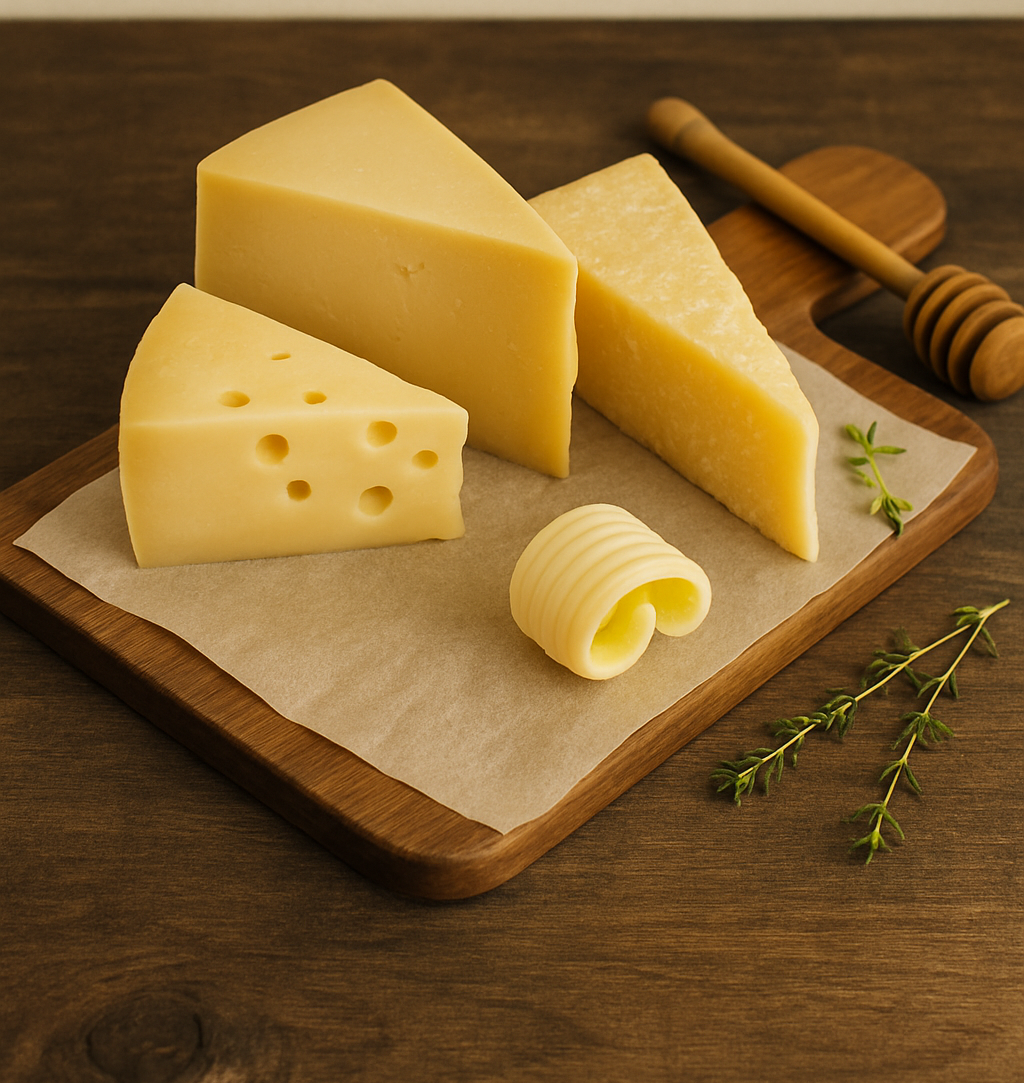
It’s the age-old breakfast dilemma: slather your toast with butter or crown it with a slice of cheese? If your kettle could talk, it would probably ask the same while the crumpets crisp up.
Now, if you’re trying to eat healthy without giving up all things creamy and delicious, this dairy duel might just matter more than you think.
Here in the UK—where the spring breeze calls for garden teas and warm scones—cheese and butter are pantry royalty. But are they both deserving of the crown? Or is one sneakily sabotaging your health goals while the other gets away in a cheddar cloak?
This post dives deep into the nutritional nitty-gritty and lifestyle realities of butter and cheese, especially in the context of heart health, weight management, and even gut happiness.
So stick with us (not just like melted butter on toast), and let’s crown the true dairy champion!
🥇 Quick Summary: Who Wins the Health Crown?
“Cheese has the edge—thanks to higher protein, calcium, and probiotic potential. But it’s a close race!”
Butter is more of a fat bomb—delicious, yes, but light on nutrients. Cheese, especially aged varieties, offers more protein, calcium, and sometimes even gut-friendly bacteria¹.
1. Nutritional Face-Off: Fat, Protein, and Calories
Let’s break it down per 100g (we know you’re not eating that much, but humour us):
| Nutrient | Butter | Cheese (Cheddar) |
|---|---|---|
| Calories | ~717 kcal | ~403 kcal |
| Total Fat | ~81g | ~33g |
| Saturated Fat | ~51g | ~21g |
| Protein | ~1g | ~25g |
| Calcium | ~24mg | ~720mg |
🧠 “Did you know… Cheese packs over 25x more calcium than butter?”
Butter is nearly all fat, which is why it melts beautifully on hot toast. But it lacks protein, calcium, and other nutrients that actually help your body function.
Cheese has fat, yes, but it also brings a hearty serving of protein, B12, calcium, and zinc—nutrients your bones, brain, and immune system adore².
2. Heart Health: Friend or Foe?
Here’s where the debate gets tasty—and complicated.
Butter’s Bad Rap (Mostly Earned)
Butter has long been associated with higher LDL cholesterol levels, due to its whopping 51g of saturated fat per 100g³.
Eating too much saturated fat can raise your ‘bad’ LDL cholesterol, increasing heart disease risk.”⁴
This doesn’t mean butter is evil—it’s just that your heart prefers moderation.
Cheese’s Curveball: The “Cheese Paradox”
Surprisingly, several studies suggest that cheese doesn’t raise LDL cholesterol as much as expected, even with its saturated fat content⁵.
Some scientists think the calcium in cheese binds with fat in your gut, helping you excrete it rather than absorb it⁶.
🧀 “Cheese may be fatty, but it’s not as heart-hurting as butter. Your arteries might just agree.”
Winner: Cheese (but opt for hard, aged types in moderation)
3. Weight Management: Which Keeps You Fuller?
Let’s face it: food is fuel—but it’s also comfort. The key to healthy weight? Feeling full and satisfied with less.
Cheese = Protein Power
Thanks to its high protein content, cheese keeps you full longer. Protein boosts satiety hormones like peptide YY and GLP-1, which help regulate hunger⁷.
Butter, on the other hand? It’s more like… a flare of pleasure, gone in seconds.
🍽️ “If you’re watching your waistline, cheese is far more satisfying than a pat of butter.”
Bonus: Some cheeses are naturally lower in fat, like cottage cheese or reduced-fat cheddar—great for snacks without guilt.
4. Gut Health: Surprise Contender!
Here’s a dairy twist you might not expect…
Cheese as a Probiotic Source
Fermented cheeses like Gouda, Cheddar, and Parmesan can contain live bacteria that support gut health⁸. These beneficial microbes help maintain a healthy microbiome, which affects everything from immunity to mood.
Butter? Unless it’s raw, cultured butter (rare in shops), it’s pasteurised and sterile—zero live goodies.
🦠 “Aged cheeses may give your gut the probiotic boost butter simply can’t.”
Winner: Cheese again
5. Cooking & Versatility: Different Roles, Different Goals
Butter is a culinary multitool. It browns, bastes, and brings flaky joy to scones and pastries. Nothing beats its rich depth when pan-frying or baking.
Cheese, meanwhile, melts, grills, and grates into meals to add protein and flavour.
👩🍳 “Use butter for cooking, cheese for nutrition. Don’t flip the script.”
Top Tip: When cooking with butter, try using half olive oil, half butter—you’ll lower the saturated fat and still get the flavour kick!
6. Lactose & Tummy Tolerance
For folks sensitive to dairy, the type of dairy really matters.
Butter contains very little lactose, since it’s mostly fat. So even lactose-intolerant individuals can usually enjoy a small spread.
Hard cheeses like Cheddar, Parmesan, and Swiss also contain minimal lactose due to fermentation.
You won’t believe what happens next! 🍞🧀
💡 “Soft cheeses like Brie or Mozzarella have more lactose—so tread lightly if you’re sensitive.”
7. Bone Health: Who Builds You Up?
Calcium is queen when it comes to strong bones, and cheese wears the crown here.
One slice of cheddar (~30g) can contain over 200mg of calcium—that’s nearly a quarter of your daily requirement⁹.
Butter? Practically nothing.
🦴 “Want stronger bones? Say cheese.”
Especially important for postmenopausal women, kids, and anyone with a history of bone issues.
8. The Vitamin Factor: A, K2, D & Friends
Both cheese and butter contain fat-soluble vitamins, but with different strengths.
| Vitamin | Butter (per 100g) | Cheese (per 100g) |
|---|---|---|
| Vitamin A | ~684µg | ~265µg |
| Vitamin D | Trace (varies) | Trace (varies) |
| Vitamin K2 | Low in regular butter | Higher in aged cheese |
| Vitamin B12 | Negligible | ~1.5µg |
Butter is richer in Vitamin A, great for vision and skin. But aged cheese contains more K2, which helps shuttle calcium into your bones and out of arteries—very handy for heart and bone health¹⁰.
Winner: Cheese edges it out with its K2 + B12 combo.
9. Sourcing Matters: Choose Wisely
🛒 “Not all cheese and butter are created equal—source matters.”
At Quidian Naturals, we always say: know what you’re spreading or slicing. Look for:
- Grass-fed dairy (higher in Omega-3s and CLA)
- Organic options (fewer residues, better animal welfare)
- Unprocessed, minimal ingredient lists
Butter from grass-fed cows has more conjugated linoleic acid (CLA)—a compound linked to anti-inflammatory effects¹¹. Some premium butters (like Irish or French) are more nutritious and tasty.
Cheese too—aged, minimally processed varieties offer more nutrients and fewer additives.
10. Which One Should I Keep in My Fridge?
- Weight-loss & fullness? → Cheese
- Heart health? → Cheese (moderately)
- Cooking? → Butter
- Lactose-friendly? → Both (choose hard cheese)
- Gut health? → Cheese (especially aged)
- Calcium? → Cheese
- Vitamin A? → Butter
🥇 “Verdict: If you must pick one—cheese is the nutritional winner. But they’re best when used purposefully and in moderation.”
Conclusion
In the grand battle of butter vs. cheese, there’s no absolute villain—only context. Want to keep your meals comforting and nourishing? Choose cheese for protein, probiotics, and calcium, and butter for flavour and finesse.
It’s not about quitting either—it’s about using each wisely. And hey, sometimes a proper crumpet needs both.
At Quidian Naturals, we believe in empowering your wellness journey with simple swaps, joyful indulgence, and nature’s wisdom.
🧾 Want our free “Better Dairy Swaps” printable?
Get it on QuidianNaturals.co.uk and follow us for more delicious, down-to-earth health guides.
References
- Harvard T.H. Chan School of Public Health. Cheese. The Nutrition Source. Accessed May 2025. https://www.hsph.harvard.edu/nutritionsource/food-features/cheese/
- Dairy Council UK. Cheese – Nutrition and Health. Milk.co.uk. Accessed May 2025. https://www.milk.co.uk/dairy-products/cheese/
- British Heart Foundation. Butter vs. Margarine – Which is Better for Your Heart? https://www.bhf.org.uk/informationsupport/heart-matters-magazine/nutrition/butter-or-margarine
- NHS UK. Saturated fat – the facts. Live Well, Eat Well. Updated 2023. https://www.nhs.uk/live-well/eat-well/different-fats/
- Hjerpsted, J., Leedo, E., & Tholstrup, T. (2011). Cheese intake in large amounts lowers LDL-cholesterol concentrations compared with butter intake of equal fat content. American Journal of Clinical Nutrition, 94(6), 1473–1479. https://doi.org/10.3945/ajcn.111.022426
- Thorning, T.K., Bertram, H.C., Bonjour, J.P., et al. (2015). Milk and dairy products: good or bad for human health? An assessment of the totality of scientific evidence. Food & Nutrition Research, 59, 28619. https://www.ncbi.nlm.nih.gov/pmc/articles/PMC4424968/
- Westerterp-Plantenga, M.S., Lejeune, M.P.G.M., Nijs, I., van Ooijen, M., & Kovacs, E.M.R. (2004). High protein intake sustains weight maintenance after body weight loss in humans. International Journal of Obesity, 28, 57–64. https://doi.org/10.1038/sj.ijo.0802461
- Marco, M.L., Heeney, D., Binda, S., et al. (2017). Health benefits of fermented foods: microbiota and beyond. Current Opinion in Biotechnology, 44, 94–102. https://pubmed.ncbi.nlm.nih.gov/28279486/
- National Osteoporosis Society UK. Calcium-rich foods. Royal Osteoporosis Society. https://theros.org.uk/information-and-support/healthy-living/food-and-diet/calcium/
- Beulens, J.W.J., van der A, D.L., Grobbee, D.E., et al. (2009). Dietary phylloquinone and menaquinones intakes and risk of type 2 diabetes. Diabetes Care, 33(8), 1699–1705. https://doi.org/10.2337/dc09-2302
- Parodi, P.W. (1999). Conjugated linoleic acid and human health: An overview of the literature. Food Australia, 51(12), 540–544. https://www.researchgate.net/publication/284923819